“Joseph Conrad was, famously, trilingual in Polish, French and English, and was also familiar with German, Russian, Dutch, and Malay. Additionally, he was a consummate stylist, using words with the precision of a poet in his fiction”
(from “Conrad and Language”, multiple authors, edited by Katherine Isobel Baxter and Robert Hampson, Edinburgh University Press, 2016)
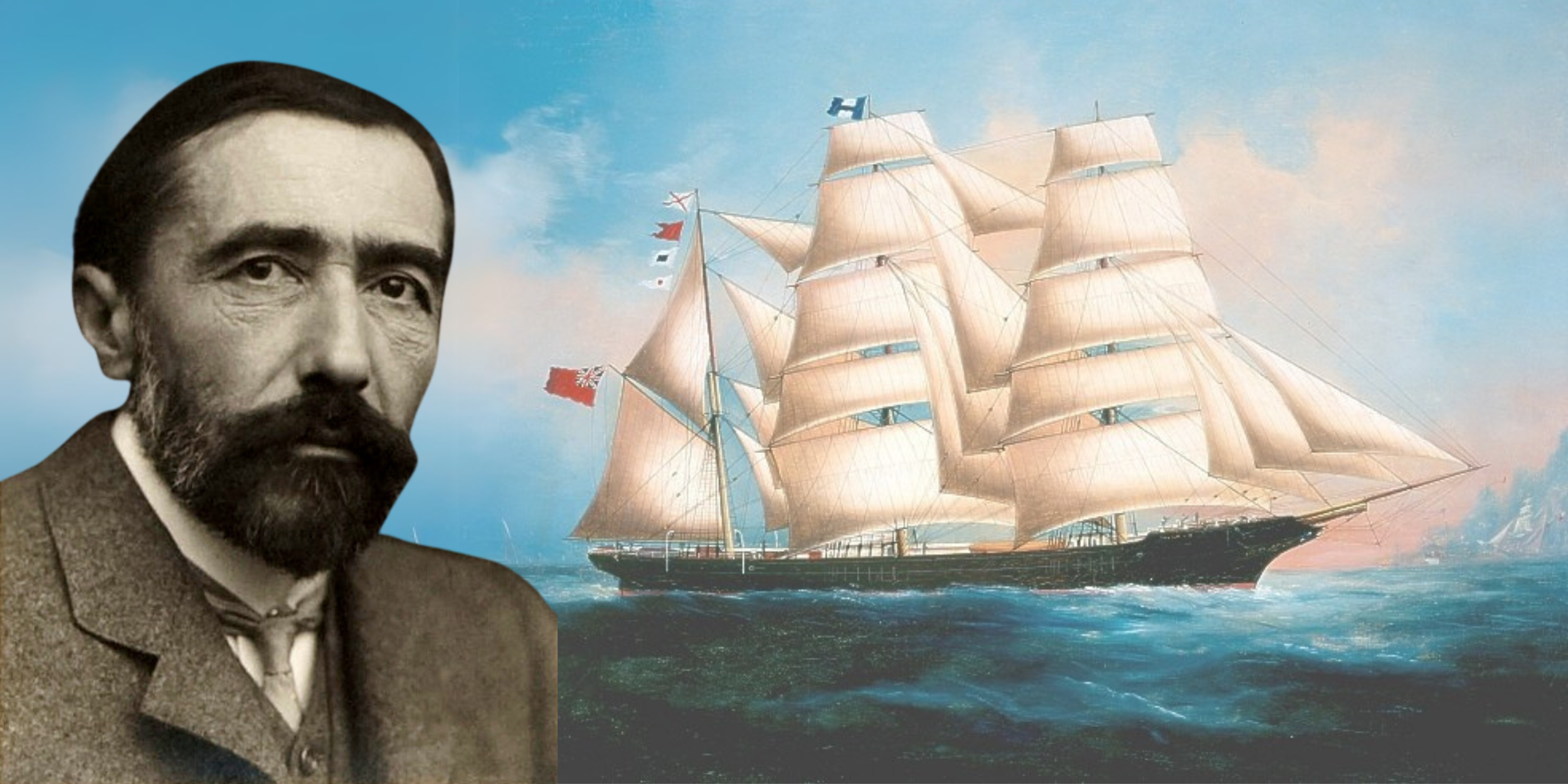
Conrad was born in Berdychiv, now in Ukraine, in 1857. Conrad’s family were members of the Polish gentry. As a result, Conrad learned French early, like other children of this class. Conrad therefore mastered Polish and French early in his life, and was also familiar with Latin. At that time, Poland as a country did not exist; it had been divided between Russia and Austria. Until Conrad became a British subject in 1886, he travelled on Russian documents.
Conrad lived between the Russian and Austrian parts of Poland. Consequently, Conrad became a speaker of both Russian and German, though not reaching full fluency in either language.
Conrad’s parents died before he reached adulthood and in 1874, at the young age of sixteen, Conrad travelled to Marseilles in France, where he sailed on French merchant ships. English was a common language of communication, among many others, and Conrad learned the basics of English then.
Four years later, he joined a British ship, which gave him prolonged contact with English people and the English language. He then settled in London.
Conrad had begun learning conversational English during his numerous travels, and in London he developed his mastery of the English language, both spoken and written, notably through reading English literature. He became fluent in English in his twenties.
Through his many travels to the Caribbean, Australia, India, Mauritius, Singapore, and Congo, and his life in the merchant marine trade, where multiple communities and languages coexisted, Conrad learned many additional languages to varying degrees including Dutch, Italian, Spanish, Malay, and Kilongo.
One can speculate that Conrad’s exceptional multilingualism and precociousness shaped his brain capabilities, enabling him to learn languages more easily and effectively. Nevertheless, Conrad’s multilingualism was uneven. For instance, Conrad’s fluency in French was not perfect. According to some studies, Conrad made frequent and sometimes significant mistakes in French. This is hardly surprising: how many native French speakers can truly master the complexities of their own language after years of hard studying in school?
Over the decades, multiple studies on Conrad have also highlighted the influence of his multilingualism in the unique style that he brought to his English writing.
Conrad’s life was complicated by a turbulent geopolitical context. An orphan from a very early age, he had to fend for himself. Through his travels, he mastered multiple languages, and when he finally settled in London, he graced us with his great literary works. He taught us that language proficiency is inherently uneven, and that oral learning is essential before a language can be further mastered.
References
Baxter Katherine Isobel & Hampson Robert, Conrad and Language, Edinburgh University Press, 2016